The divorce rate is near a 50-year low. See what the latest numbers really show, and what we can all do to help more marriages last.


The Real Divorce Numbers, and How We Turn the Tide
Ask almost anyone about divorce and you’ll hear the same line: “Half of all marriages end in divorce.” It’s repeated in sermons, sitcoms and break rooms, and it quietly tells young couples that marriage is a coin toss.
It isn’t. The U.S. divorce rate has been falling for more than four decades and is now near a 50-year low. Researchers estimate that about 42% of first marriages today will end in divorce if current patterns hold. That’s still far too many hurting families, but it’s not a coin toss. And the research is just as clear about something more hopeful: much of what keeps a marriage together can be learned, practiced and supported.
What the numbers say now
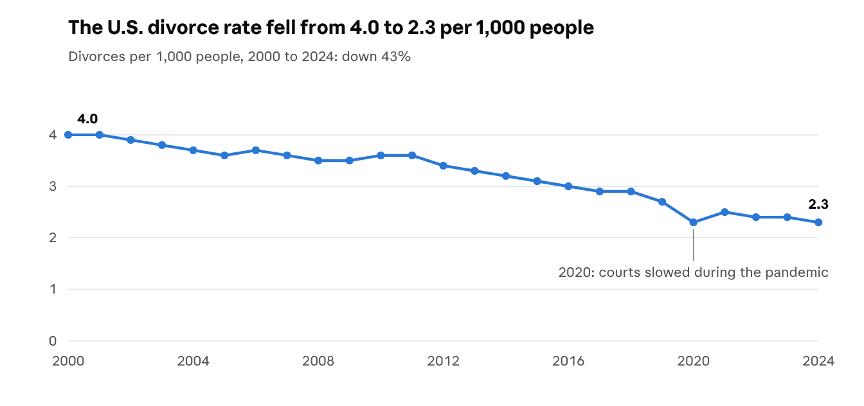
In 2024 the CDC counted 662,950 divorces in the states that report them, or 2.3 for every 1,000 people, down from 4.0 in 2000. Researchers at Bowling Green State University, who count divorces per 1,000 married women, found 14.2 in 2024, down from a peak of 22.6 in 1980.
Part of the story is that fewer people are marrying: the marriage rate fell from 8.2 to 6.3 per 1,000 over the same years. But the couples who do marry are staying together more often than their parents’ generation did. The “half of all marriages” line comes from the divorce boom of the 1970s and 1980s, and it no longer fits.
Why marriages still end
When researchers ask divorced people why their marriages ended, the same answers come up again and again, and most of them aren’t sudden.
In a large Oklahoma survey, divorced respondents most often named a lack of commitment, too much conflict and arguing, and infidelity. A later study of couples who had taken premarital classes through their churches found the same top three: lack of commitment, infidelity and conflict. In a study of 886 parents already in the divorce process, the two most common reasons were simply growing apart and “not being able to talk together.”
Notice what that list mostly describes: slow erosion. Couples drift. Arguments go unresolved. Commitment thins out over years of busyness and hurt. These are exactly the things a couple can work on, and that the people around them can help with, long before anyone talks to a lawyer.
Not every divorce is preventable, and not every marriage should be saved at any cost. In the same Oklahoma survey, 44% of divorced women named domestic violence as a major reason. No one should stay in a home where they are being harmed. Getting safe is never a failure of faith.
What protects a marriage
The hopeful side of the research is that some things make a measurable difference.
- Preparing before the wedding. A large survey of adults in Oklahoma, Texas, Arkansas and Kansas, published in the Journal of Family Psychology in 2006, found that couples who took premarital education had about a 31% lower chance of divorce, and reported happier marriages, than couples who didn’t.
- Sharing a faith community. In a study of more than 66,000 married women followed for 14 years, those who attended religious services frequently had about a 50% lower risk of divorce. Shared worship gives couples a common center, a community that cares whether they stay together, and practices like forgiveness that marriages depend on.
- Learning to handle conflict. Since conflict and “not being able to talk together” are among the top reasons people give for divorce, skills like listening well, fighting fair and repairing after an argument are protective. They can be taught, and they can be practiced.
- Not walking alone. Couples who have people in their corner, such as friends who are for their marriage, a church that notices when they’re struggling, or a mentor couple a few miles further down the road, have somewhere to turn before small problems become big ones.
Turning the tide
The divorce rate has already been falling for decades. The question is whether we’ll be content with “less bad,” or whether we’ll help more marriages not just survive, but flourish.
What couples can do
- Check in before you check out. Set aside 20 to 30 minutes a week to talk about how you’re really doing, not just whose turn it is to drive the kids.
- Learn the skills. Take a marriage class, read a good book together, or use a tool that walks you through hard conversations. Skills beat good intentions.
- Guard your friendship. A weekly date, a daily hug that lasts, real curiosity about each other’s day. Growing apart happens slowly, and so does growing together.
- Ask for help early. The best time to see a mentor or counselor is when things are hard, not when they’re over.
What churches can do
- Make premarital preparation the norm, not an optional add-on.
- Train mentor couples who can walk alongside newlyweds and couples in crisis.
- Talk honestly about marriage from the pulpit, including the hard seasons, so couples know they aren’t the only ones struggling.
- Make it safe to ask for help, without shame and with confidentiality.
What all of us can do
Be for the marriages around you. Encourage a friend who’s struggling to get help instead of simply taking their side. Babysit so a young couple can have a date. Celebrate anniversaries. Marriages are strengthened by communities that expect them to last.
Every marriage counts
Statistics describe millions of people. Your marriage is one. The trend lines matter less than what you and your spouse do this week.
At MarriageScape, that’s what we’re here for. Take the Side by Side couples assessment together to see where you’re strong and where you could grow. Try Couple Challenges, a few minutes a day for 7 to 30 days. Hold a Weekly Marriage Meeting. And if you’d like someone to walk alongside you, request a Navigator couple: a trained mentor couple who has been where you are.
The tide is already turning. Let’s help it turn faster, one marriage at a time.